
Overview
Endocrine glands and hormones
The main hormones of the endocrine system according to site are:
- Hypothalamus:
- Corticotropin-releasing hormone (CRH)
- Thyrotropin-releasing hormone (TRH)
- Growth hormone-releasing hormone (GHRH)
- Growth hormone-inhibiting hormone (GHIH, also known as somatostatin)
- Gonadotropin-releasing hormone (GnRH)
- Anterior pituitary:
- Adrenocorticotropic hormone (ACTH)
- Thyroid-stimulating hormone (TSH)
- Growth hormone (GH)
- Prolactin
- Follicle-stimulating hormone (FSH)
- Luteinising hormone (LH)
- Posterior pituitary:
- Antidiuretic hormone (ADH, also known as vasopressin)
- Oxytocin
- Adrenal cortex – superficial to deep:
- Zona glomerulosa – aldosterone
- Zona fasciculata – glucocorticoids
- Zona reticularis – androgens
- Adrenal medulla:
- Noradrenaline
- Adrenaline
- Thyroid gland:
- Thyroid hormones (T3 and T4)
- Parathyroid glands:
- Parathyroid hormone (PTH)
- Pancreas:
- Insulin
- Glucagon
- Growth hormone-inhibiting hormone (GHIH, also known as somatostatin)
- Pineal gland:
- Melatonin
- Testis:
- Testosterone
- Ovary:
- Oestrogen
- Progesterone
Hypothalamic-pituitary-adrenal axis
Overview
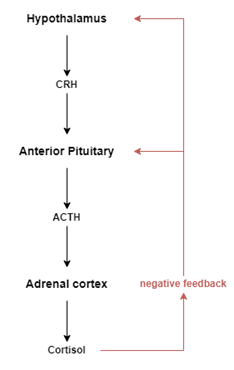
The hypothalamic-pituitary-adrenal axis (HPA axis) describes the interactions between the hypothalamus, pituitary gland, and adrenal glands. This axis is responsible for the body’s stress response and modulates bodily processes including:
- Suppression of the immune system
- Increasing blood glucose
- Increasing the rate of metabolism
- Increasing alertness
Mechanism
The hypothalamus releases corticotropin–releasing hormone (CRH) which stimulates the anterior pituitary gland to release adrenocorticotropic hormone (ACTH). This stimulates the adrenal glands to release cortisol.
The release of CRH is typically influenced by stresses on the body, such as illness and physical exertion. Cortisol varies throughout the day, and typically peaks in the morning, then falls in the late evening, contributing to a regular sleep-wake cycle.
The release of cortisol exerts negative feedback on the hypothalamus and anterior pituitary gland, suppressing the release of CRH and ACTH. This allows for cortisol levels to be closely regulated and kept within normal limits.
Hypothalamic-pituitary-thyroid axis
Overview
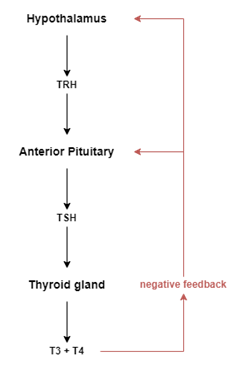
The hypothalamic–pituitary–thyroid axis (HPT axis) describes the interactions between the hypothalamus, pituitary gland, and thyroid gland. This axis is responsible for regulating the body’s metabolism.
Mechanism
The hypothalamus releases thyrotropin-releasing hormone (TRH) which stimulates the anterior pituitary gland to release thyroid-stimulating hormone (TSH). This stimulates the thyroid glands to release thyroid hormones (triiodothyronine (T3) and thyroxine (T4)).
The release of thyroid hormone exerts negative feedback on the hypothalamus and anterior pituitary gland, suppressing the release of TRH and TSH. This allows for thyroid hormone levels to be closely regulated and kept within normal limits.
Hypothalamic-pituitary-somatotropic axis
Overview
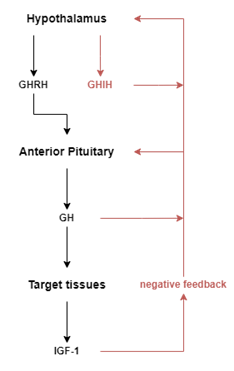
The hypothalamic–pituitary–somatotropic axis (HPS axis) describes the interactions between the hypothalamus, pituitary gland, and target tissues such as the liver, muscles, and bone. This axis is responsible for regulating the body’s growth.
Mechanism
The hypothalamus releases growth hormone–releasing hormone (GHRH) which stimulates the anterior pituitary gland to release growth hormone (GH). This stimulates target tissues such as the liver, muscles, and bone, to release insulin–like growth factor 1 (IGF–1).
The control of GH is different. IGF–1 and GH exert negative feedback on the anterior pituitary gland and hypothalamus. As well as this, the hypothalamus itself releases another hormone known as growth hormone–inhibiting hormone (GHIH, also known as somatostatin), which exerts negative feedback on the hypothalamus.
Hypothalamic-pituitary-gonadal axis
Overview
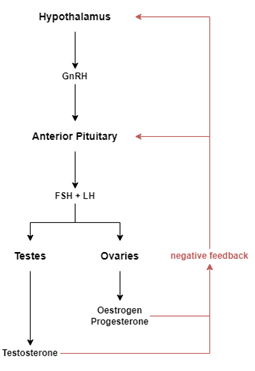
The hypothalamic–pituitary–gonadal axis (HPG axis) describes the interactions between the hypothalamus, pituitary gland, and the gonads (testes in males, ovaries in females). This axis is responsible for regulating the development and function of the reproductive system.
Mechanism
The hypothalamus releases gonadotropin–releasing hormone (GnRH) which stimulates the anterior pituitary gland to release follicle–stimulating hormone (FSH) and luteinising hormone (LH). These stimulate the testes to produce testosterone, and the ovaries to produce oestrogen and progesterone. These hormones exert negative feedback on the anterior pituitary gland and the hypothalamus, allowing for the control of their levels.
The release of thyroid hormone exerts negative feedback on the hypothalamus and anterior pituitary gland, suppressing the release of TRH and TSH. This allows for thyroid hormone levels to be closely regulated and kept within normal limits.
Control of Blood Glucose Concentration
Insulin and glucagon
When the blood glucose concentration is elevated, the beta cells of the Islets of Langerhans in the pancreas secrete insulin, which reduces the blood glucose concentration through:
- Glycogenesis – converting glucose into glycogen
- Increased entry of glucose into cells
- Increased synthesis and reduced breakdown of fatty acids and proteins
When the blood glucose concentration is very low, the alpha cells of the Islets of Langerhans in the pancreas secrete glucagon, which increases the blood glucose concentration through:
- Glycogenolysis – breaking down glycogen into glucose
- Gluconeogenesis – increased synthesis of glucose from amino acids or lipids
Other hormones
There are many other hormones implicated in the control of blood glucose concentration, including:
- Cortisol – increases glucose
- Growth hormone – increases glucose
- Thyroxine – increases glucose
- GLP–1 (glucagon–like peptide 1) – lowers glucose
- Somatostatin – lowers glucose
Renin-angiotensin-aldosterone system
Overview
The renin-angiotensin–aldosterone system (RAAS) system is a hormone system that regulates blood pressure, along with fluid and electrolytes. Reduced blood flow to the juxtaglomerular cells in the kidneys leads to the secretion of renin (an enzyme) into the circulation. The liver releases angiotensinogen, which is cleaved by renin to form angiotensin I. Angiotensin I is converted into angiotensin II by angiotensin–converting enzyme (ACE) predominantly in the lungs.
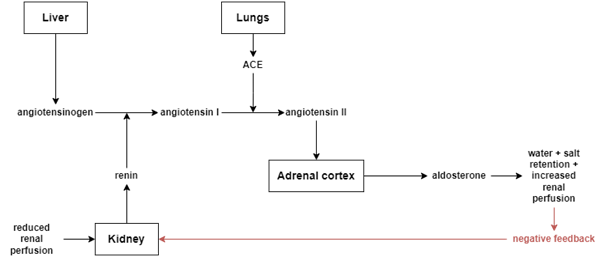
Angiotensin II leads to the following:
- Vasoconstriction of vascular smooth muscle – increases blood pressure
- Acts at the hypothalamus to stimulate ADH release and stimulates thirst
- Acts on the renal tubules to increase Na+ and Cl- reabsorption, water retention, and K+ excretion
- Acts on the adrenal gland cortex to release aldosterone
Aldosterone
Mineralocorticoids affect electrolyte and fluid balance, and aldosterone is the main endogenous mineralocorticoid. In summary, it retains sodium ions and increases the excretion of potassium ions. Since the sodium ions are retained, water follows, increasing the water content in the body. As there is a larger volume of fluid in the circulation, the blood pressure increases.
